
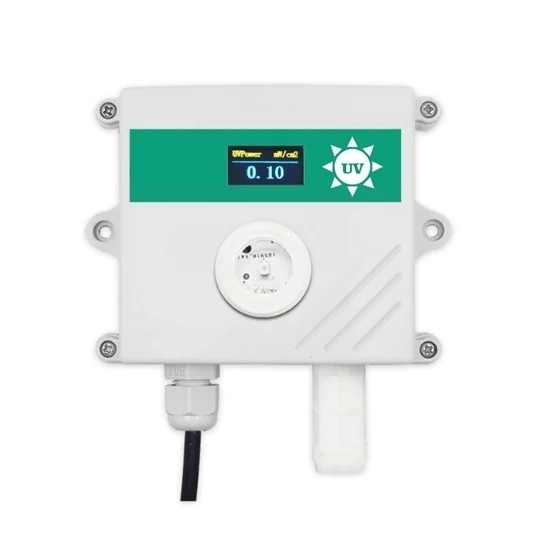
Description
The UV light intensity sensor measures 0-15mW/cm² in the 240-370nm range with ±10% accuracy at 365nm. It operates on 10-30V DC, supports 485 ModBus-RTU, and offers 4-20mA or 0-5V/0-10V outputs with a 0.2s response time.
Specification
| Model | ATO-VMS-UV-*-2 | |
| DC Power Supply (Default) | 485 (ModBus-RTU Protocol) | DC10-30V |
| 0~10V | DC24V | |
| 4~20mA / 0~5V | DC10-30V | |
| Maximum Power | 1.2W | |
| Typical Accuracy | ±10% FS (@365nm, 60%RH, 25°C) | |
| UV Intensity Range | 0~15mW/cm², 0~450 μW/cm² | |
| Measurement Wavelength Range | Wavelength 240-370nm | |
| Operating Environment | -40°C~+60°C, 0%RH~80%RH | |
| Response Time | UV Intensity | 0.2s |
| Output Signal | 485 (ModBus-RTU Protocol) | |
| Current Output | 4mA~20mA | |
| Voltage Output | 05V / 010V | |
| Load Capacity | Current Output | Load Capacity ≥600Ω |
| Voltage Output | Output Impedance ≤250Ω |
Features
- High Sensitivity Sensor: Equipped with a high-sensitivity UV sensor, accurately measuring UV intensity within a wavelength range of 240-370 nm.
- Premium Transmitting Materials: Made with high-quality light-transmitting materials for enhanced measurement accuracy and reliability.
- OLED Display: Supports OLED screen for clear and real-time display of UV intensity and UV index, making monitoring more intuitive.
- Durable, High-Protection Shell: Features a robust, waterproof, and dustproof exterior suitable for harsh outdoor environments, withstanding rain and snow.
- Superior Anti-Interference: Designed to maintain accurate readings even in high-interference settings, ensuring stable performance.
- High-Quality Sensor Components: Incorporates reliable, high-precision components for consistent and stable UV measurements.
Wiring Method
| Category | Wire Color | Description |
| Power Supply | Brown | Power Positive (10~30V DC) |
| Black | Power Negative | |
| Communication | Blue | UV Intensity Signal Positive |
| Green | UV Intensity Signal Negative |
Application
Tips: What benefits does the OLED display offer on this UV sensor?
The OLED display provides a clear and immediate visual output of UV intensity and UV index values, making it easy to read data in real-time without additional devices. Unlike traditional LCDs, OLED displays offer better contrast, are viewable from wider angles, and consume less power, making them efficient for long-term use. The display also enhances usability by allowing users to see accurate readings even in dimly lit environments, which is particularly beneficial for both indoor and outdoor monitoring applications.
Reviews
There are no reviews yet.