
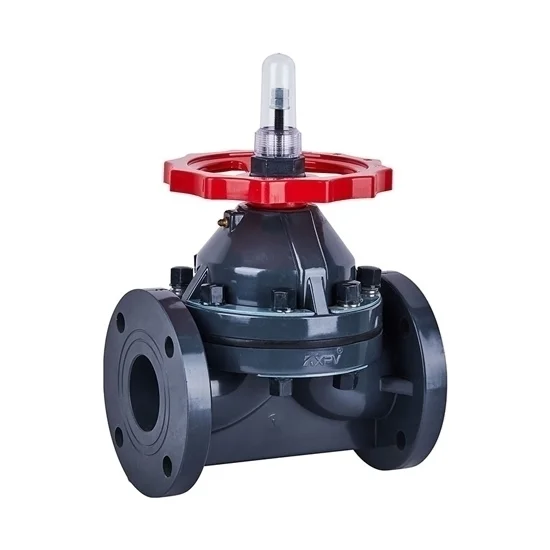
Description
Note: This diaphragm valve cannot be used for drinking water.
PVC diaphragm valve consists of a UPVC or CPVC body with an inlet and outlet and a diaphragm that separates these two ports. When the valve is in the closed position, the diaphragm seals against the body, preventing the flow of fluid.
Specification
| Model | ATO-FDV-DN125 | |
| Size | 5 inch (DN125) | |
| Structure Type | Flanged Type | |
| Diaphragm Valve Assembly | Parts | Material |
| Diaphragm | PTFE | |
| Film | EPDM | |
| Valve Body | UPVC, CPVC | |
| Valve Plate | UPVC, CPVC, Steel, Stainless Steel | |
| Cover Limit | AS | |
| Stud | Steel, Stainless Steel | |
| Retaining Nut | FRPP | |
| Washer | FRPP | |
| Wheel | Alloy Material | |
| Platen | Steel, Stainless Steel | |
| Double-Headed Stud and Nut | Steel, Stainless Steel | |
| Bonnet | UPVC, CPVC | |
| Yoke Nut | Ht300 Steel | |
| Stem | Steel, Stainless Steel |
Dimension (Unit: mm)
| Size | Valve Body Material | d | D | L | h | n-φ |
| 5 inch (DN125) | UPVC | 248 | 213 | 400 | 30 | 8-φ18 |
| CPVC | 248 | 213 | 400 | 28 | 8-φ18 |
Note: The above dimensions are for reference only, please refer to the actual product.
Detail
Working Pressure
| Size | Working Pressure (MPa) | |||||
| UPVC | CPVC | |||||
| 20~40℃ | 41~60℃ | 61~80℃ | 0~40℃ | 41~60℃ | 61~90℃ | |
| 1/2″ (DN15) | 0.8 | 0.8 | 0.7 | 0.7 | 0.7 | 0.6 |
| 3/4″ (DN20) | 0.8 | 0.8 | 0.7 | 0.7 | 0.7 | 0.6 |
| 1″ (DN25) | 0.8 | 0.8 | 0.7 | 0.7 | 0.7 | 0.6 |
| 1-1/4″ (DN32) | 0.7 | 0.7 | 0.6 | 0.7 | 0.7 | 0.6 |
| 1-1/2″ (DN40) | 0.7 | 0.7 | 0.6 | 0.7 | 0.7 | 0.5 |
| 2″ (DN50) | 0.7 | 0.7 | 0.6 | 0.7 | 0.7 | 0.5 |
| 2-1/2″ (DN65) | 0.7 | 0.7 | 0.6 | 0.7 | 0.7 | 0.5 |
| 3″ (DN80) | 0.7 | 0.7 | 0.6 | 0.7 | 0.7 | 0.5 |
| 4″ (DN100) | 0.7 | 0.7 | 0.6 | 0.7 | 0.6 | 0.5 |
| 5″ (DN125) | 0.5 | 0.5 | 0.4 | 0.5 | 0.5 | 0.4 |
| 6″ (DN150) | 0.5 | 0.5 | 0.4 | 0.5 | 0.4 | 0.3 |
| 8″ (DN200) | 0.3 | 0.3 | 0.2 | 0.5 | 0.3 | 0.25 |
| 10″ (DN250) | 0.3 | 0.3 | 0.2 | 0.3 | 0.3 | 0.2 |
Tips: Difference between a butterfly valve and a diaphragm valve
Butterfly valves and diaphragm valves are both types of flow control valves used in various industries. The primary difference lies in their design and operation:
Butterfly Valve:
- A butterfly valve has a disc-shaped closure element that pivots around a central axis to control flow.
- It operates by turning the disc 90 degrees to either fully open or close the flow passage.
- Offers quick and efficient flow control with a low pressure drop.
- Suitable for applications requiring on/off or throttling control, such as in HVAC systems and large water pipelines.
- Relatively lower maintenance requirements and cost-effective.
Diaphragm Valve:
- A diaphragm valve uses a flexible diaphragm or membrane to isolate the flow stream from the valve body.
- It controls flow by compressing or retracting the diaphragm to allow or block fluid passage.
- Ideal for applications requiring a high level of containment or purity, such as in the pharmaceutical and chemical industries.
- Provides excellent sealing, preventing cross-contamination and leakage.
- Generally more complex and expensive than butterfly valves, with higher maintenance requirements.
Reviews
There are no reviews yet.