
Description
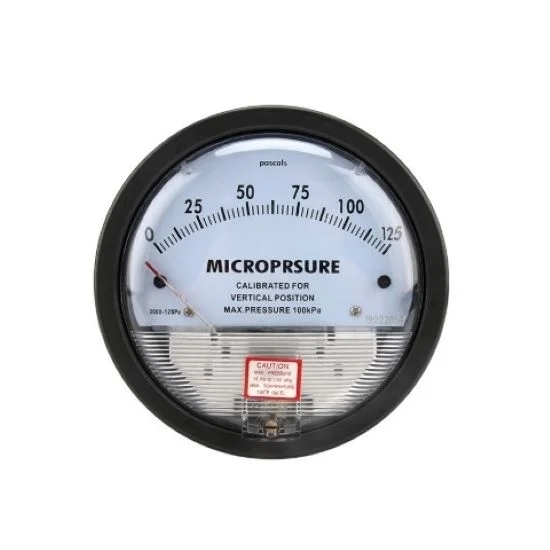
The mechanical differential pressure gauge is a robust and highly accurate instrument engineered for measuring low differential pressures in a wide range of industrial and laboratory settings. With its durable construction, clear display, and user-friendly design, analog differential pressure gauge meets the needs of professionals requiring precise pressure monitoring.
Specification
| Parameter | Details |
| Product Name | Mechanical Differential Pressure Gauge |
| Model | ATO-TE2000 |
| Measuring Range | -1kPa to 3kPa (multiple sub-ranges available) |
| Accuracy | ±4% of full scale at 21°C |
| Housing Material | Cast aluminum, dark gray paint, acrylic panel |
| Interface | 1/8” NPT (two pairs: side/back) |
| Dimensions | Φ120mm × 55.5mm |
| Weight | Approx. 560g |
| Temperature Range | -7°C to 60°C (20°F to 140°F) |
| Installation | Vertical |
| Applicable Media | Air and compatible non-flammable gases |
Feature
-
High Precision & Durability: Offers full-scale accuracy of ±4% at 21°C, mechanical differential pressure meter with strong shock resistance and anti-interference performance, providing the stability needed for sensitive measurements.
-
Superior Construction for Longevity: Features a cast aluminum shell, acrylic panel, and high-strength PC cover, making this analog differential pressure test gauge resilient in demanding environments. The design ensures excellent cleanability and safety.
-
Responsive Aluminum Hollow Pointer: Provides inertia-free, drift-free movement with no hysteresis, ensuring this analog differential pressure indicator delivers accurate and immediate readings, a key trait for any reliable differential manometer pressure gauge.
-
Versatile Installation & Compatibility: Includes multiple 1/8” NPT interface options and mounting accessories. It serves as a fundamental tool in a suite of pressure instruments, ideal for various system integrations where a pressure calibrator or monitoring device is needed.
Dimension (unit: mm)
Detail
Application
Tips:Three Measurement Methods for Mechanical Differential Pressure Gauge
-
Measuring Positive Pressure: Connect the pressure source to one high-pressure port and seal the unused high-pressure port. Keep one or both low-pressure ports open to atmosphere.
-
Measuring Negative Pressure: Connect the vacuum or low-pressure source to one low-pressure port and seal the unused low-pressure port. Keep one or both high-pressure ports open to atmosphere.
-
Measuring Differential Pressure: Connect the higher pressure to a high-pressure port and the lower pressure to a low-pressure port. Seal the remaining unused ports.
For dirty or contaminated environments, it is recommended to use a filter vent plug to keep the gauge interior clean. Use rubber or polyethylene tubing for temporary setups and copper or aluminum tubing for permanent installations.
Reviews
There are no reviews yet.