
Description
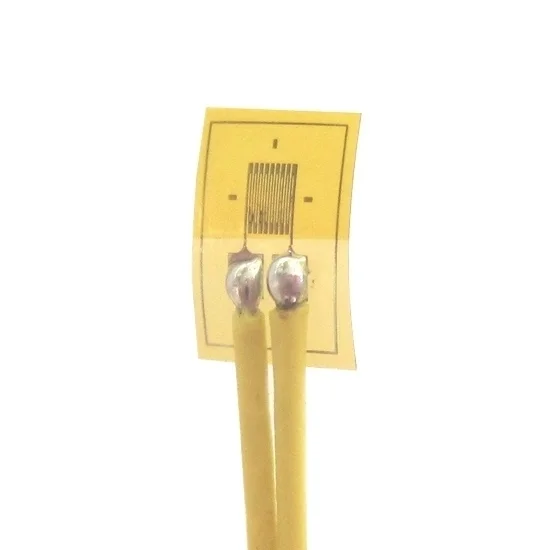
Tailored for unidirectional strain measurement, the 120 ohm uniaxial strain gauge features a standard uniaxial design, perfectly suitable for various precise testing. With a wide measurement range of up to 20,000με and an operating temperature range of -20℃ to 80℃, it can maintain stable performance in daily and industrial environments.
Specification
| Model | ATO-BX120-1AA |
| Resistance | 120Ω |
| Gauge Factor | 2.08 |
| Accuracy Class | Class A |
| Sensitive Grid Dimensions | 1*1mm |
| Base Material | Gelatinous base |
| Base Dimensions | 5*3mm |
| Measuring Range | 20000με |
| Operating Temperature Range | -20 ℃ to 80 ℃ |
| Lead Wire Length | 20cm lead wire as standard (customizable) |
Features
- Standard Uniaxial Design: This uniaxial strain gauge is specifically engineered for unidirectional strain measurement. Featuring an industry-standard 120Ω resistance, it is compatible with most static strain gauges and dynamic data acquisition systems. Ideal for precision linear stress analysis, structural testing, and material testing applications.
- High-Sensitivity Output: As a Class A high precision strain gauge with a strain coefficient of 2.08, it reliably and accurately reflects axial strain at the measurement point.
- Wide Measurement Range: Supporting a measurement range up to 20,000 με, this precision strain gauge accommodates both microstrain analysis within the elastic range and large strain testing requirements such as plastic deformation.
- Flexible Lead Configuration: The strain gauge features standard 20cm leads (custom lengths available), with factory-terminated internal connections eliminating the need for complex lead soldering.
Tips: How to distinguish between uniaxial, biaxial, and triaxial strain gauges?
From a structural perspective, the core differences between uniaxial, biaxial, and triaxial strain gauges lie in three aspects: the number of sensitive grids, their spatial arrangement, and the lead wire configuration.
- Uniaxial Strain Gauge: Contains only one independent sensitive grid arranged in a straight or parallel grid pattern, measuring linear strain in a single direction. Typically features two lead wires (some temperature-compensated designs may have three, but still contain one sensitive grid). Characterized by the principle of “one grid, one direction.”
- biaxial strain gauges: Contain two mutually perpendicular sensitive gratings (typically arranged at 0° and 90° orthogonal angles) to simultaneously measure strain components in two orthogonal directions. Lead configurations usually feature 3–4 wires (depending on whether a common terminal is shared). Their structural characteristics can be summarized as “two gratings, orthogonal, bidirectional synchronization.”
- Triaxial strain gauges (strain flowers): Incorporate three sensitive gratings, commonly arranged in a 0°-45°-90° stacked configuration or a 0°-60°-120° planar distribution. They measure planar strain fields to determine principal strain magnitude and direction. Typically features 5–6 lead wires (either independent for each sensitive grid or using a common terminal design). Its structural characteristics can be summarized as “three grids, multi-directional, capable of solving principal strains.”
Quick differentiation can be achieved by observing the number of sensitive grids on the strain gauge substrate. Additionally, the number of lead wires increases proportionally with the number of axes, serving as an auxiliary identification criterion.
Reviews
There are no reviews yet.