
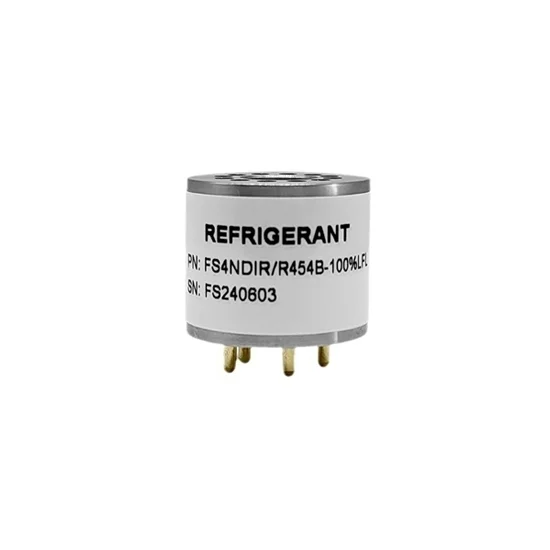
Description
This industrial-grade infrared gas sensor leverages advanced NDIR (Non-Dispersive Infrared) technology for the specific detection of R454B refrigerant gas. It offers a robust and maintenance-free solution for monitoring A2L refrigerants, characterized by high precision, stability, and resilience in challenging environments. The sensor’s compact and pump-free design simplifies integration, while its dual-channel measurement and temperature compensation ensure reliable performance.
Specification
| Model | ATO-FS4NDIR/R454B |
| Detection Gas | R454B (Hydrofluoroolefin) |
| Detection Principle | Non-Dispersive Infrared (NDIR) |
| Detection Range | 0 – 100% LFL (100% LFL = 11.49% Vol) |
| Resolution | 1% LFL |
| Accuracy | ±3.75% LFL |
| Response Time (T90) | ≤ 30 seconds |
| Power Supply | DC 3.6 V ~ 5.0 V |
| Operating Current | ≤ 85 mA (@ 5V) |
| Output Interface | Modbus (Default) / DAC (0.4V~2V, reserved) |
| Operating Temperature | -20 ℃ ~ +60 ℃ |
| Operating Humidity | 0 ~ 95% RH (Non-condensing) |
| Lifespan | 10 years |
Feature
- The NDIR refrigerant R454B gas sensor utilizes the proven NDIR principle for specific and stable gas detection.
- This refrigerant sensor features a compact, pump-free design requiring no internal tubing, simplifying installation.
- With its dual-channel design, the R454B gas sensor delivers high accuracy and excellent linear output with minimal drift.
- The best NDIR sensor boasts strong resistance to water vapor interference and gas poisoning, ensuring long-term reliability.
- Designed for durability, this gas sensor detector incorporates temperature compensation and offers a long operational lifespan.
Dimension (Unit: mm)
Working Principle
Application
5 Tips for DNIR Refrigerant A2L R454B Gas Sensor
- Ensure the gas detector sensor is installed in a location representative of the potential leak source and where air circulation is adequate for detection.
- The specified accuracy is valid within the standard pressure range of 75 kPa to 120 kPa; significant pressure deviations may affect readings.
- While highly resistant, avoid prolonged exposure to condensing humidity or direct water spray to maintain the good gas sensor integrity.
- For optimal performance and longevity, adhere to the specified operating voltage and temperature ranges.
- Regular functional checks are recommended to verify sensor performance, especially before critical operations.
Reviews
There are no reviews yet.